

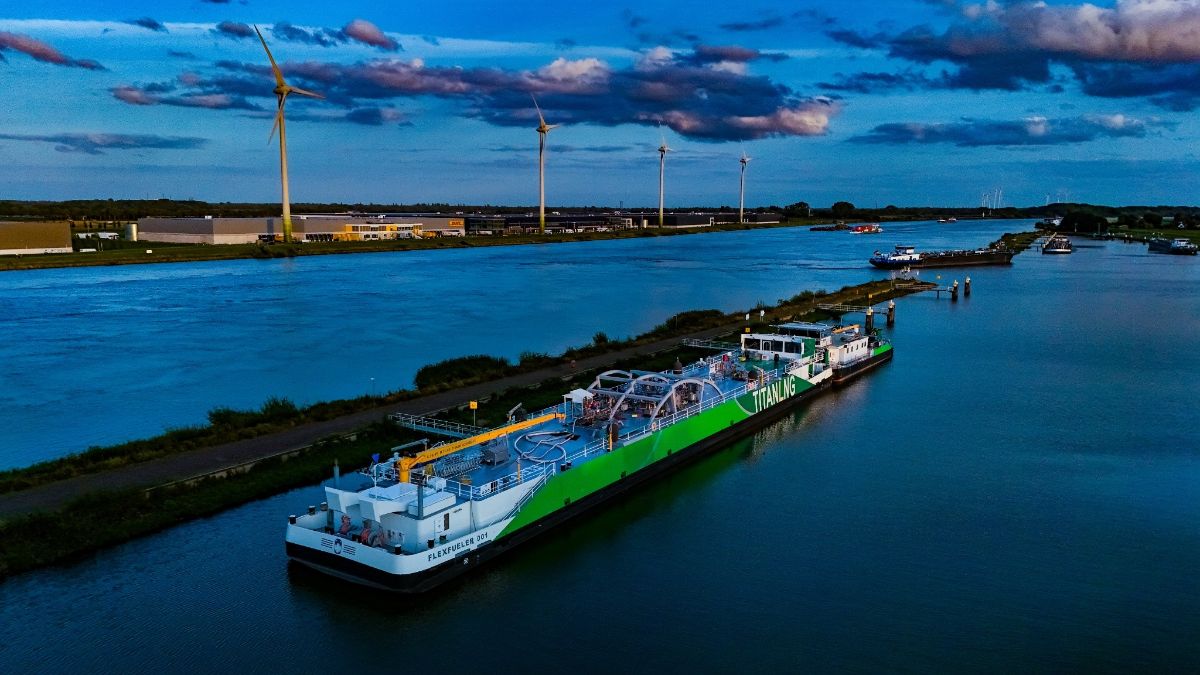
Titan to bunker e-Methane produced by TURN2X as demand for green marine fuel set to increase
Titan Clean Fuels has signed an off-take agreement with green energy supplier TURN2X to deliver e-Methane to the maritime industry from 2028 onwards. Titan operates seven bunker vessels and is able to deliver in around 52 ports today, so the new e-Methane agreement can help to significantly scale up green fuel supply.
TURN2X’s modular and load-flexible production plant in Miajadas, Spain, converts renewable energy and biogenic CO₂ into ISCC-certified e-Methane. This green fuel is then fed into the grid and transported to major European ports, where Titan bunkers it to ship operators, helping them deliver on decarbonisation.
E-Methane can achieve net-zero greenhouse gas (GHG) emissions on a well-to-wake basis, with exact reductions depending on the equipment and engine technology used. It also offers an up to 95% reduction of nitrogen oxides (NOx) and achieves virtually zero sulphur oxides (SOx) and particulate matter (PM) emissions, such as black carbon (soot).1
These emissions reductions mean ships using e-Methane will be eligible for FuelEU Maritime overcompliance and the commercial benefits of banking and pooling. Shipping companies with a compliance surplus or deficit can jump into Titan’s FuelEU pool, which is underpinned by its market expertise and long-term fuel access.
TURN2X’s e-Methane is also a certified renewable fuel of non-biological origin (RFNBO). When calculating FuelEU performance, shipping companies are able to essentially double-count the impact of RFNBO from 2025 to 2033. If RFNBO still makes up less than 1% of reported maritime energy use by 2031, ships may also be mandated to use a minimum of 2% RFNBO from 2034.
This deal also represents a concrete step toward industrial-scale e-Methane deployment and making European energy more resilient. With the EU now committed to phasing out Russian LNG, ending short-term contracts from 25 April this year and all long-term contracts from 1 January 2027, scaling up the production of green fuels like e-Methane can directly support energy security.
Phillip Kessler, CEO of TURN2X, commented: “We are happy to partner up with Titan and Molgas, leaders in clean marine fuels, to decarbonize the shipping industry with e-Methane, the fuel of choice for more and more companies in the maritime sector.”
Caspar Gooren, Commercial Director of Renewable Fuels at Titan, said: “TURN2X are true green fuel pioneers and we are excited by the significant potential of this partnership. Its team’s approach to e-Methane supply is scalable: the green fuel can be produced in regions with high volumes of low-cost renewable electricity like Spain, injected into the existing gas grid, and delivered in ports where maritime off-takers need it.
“The methane pathway – via LNG, liquefied biomethane (LBM/bio-LNG) and e-Methane – allows shipowners to decarbonise step-by-step while protecting their existing investments. By using established infrastructure, this route also offers the lowest total cost of compliance along the way. Looking at the destination, all e-fuels have similar production processes, so the price will mainly be led by the availability, costs and scalability of supply-side infrastructure – where methane has a clear head start.”
E-Methane can be ‘dropped into’ all existing LNG infrastructure with little to no modification required – including bunkering equipment, terminals and LNG dual fuel vessels. This means e-Methane is supported by LNG bunkering infrastructure in approximately 222 ports worldwide and can be used in the around 850 LNG-fuelled vessels currently in operation and the further 642 on order.2
E-Methane also has 1.6 times the energy density of methanol and twice the energy density of ammonia. A fuel with a lower energy density means either larger fuel tanks are required, leaving less space for revenue-generating cargo, or more frequent bunkering operations are needed.
Last but absolutely not least, LNG has been safely shipped around the world for 60 years with no major incidents, rigorous safety standards are in place, and crews have had thorough training on how to handle, store and bunker it, as well as operate LNG dual fuel engines. As demand for e-Methane grows into the future, it will benefit from all this existing experience and knowledge.
References:
1Sphera’s 2nd Life Cycle GHG Emission Study on the Use of LNG as Marine Fuel
2SEA-LNG ‘View from the Bridge 2025-26’ report